
GOES
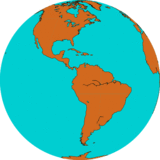
GOES-E: 75.2°W
Operator: National Oceanic and Atmospheric Administration (NOAA)
Type of orbit: Geostationary
Instrument: ABI (Advanced Baseline Imager)
Number of spectral bands: 16
Resolution at the subsatellite point: VIS/NIR: 0.5~1km, IR: 2km
Pictures are taken at 10 minutes intervals.
Images of the United States are taken every 5 minutes. It is possible to scan terrestrial areas with more frequent intervals (for example one minute, even 30 seconds) for the assistance to the NOAA alarm programs.
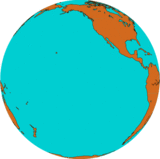
GOES-W: 137.2°W
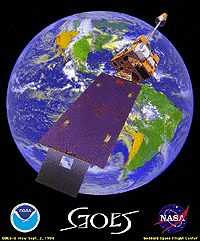
The radiometer scans the earth's surface line by line; each line consists of a series of individual image elements or pixels. For each pixel the radiometer measures the radiative energy of the different spectral bands. This measurement is digitally coded and transmitted to the ground station for pre-processing before being disseminated to the user community. The data are distributed by the National Environmental Satellite and Information Service